A handshake and a good feeling about someone are not a lease agreement. Neither, frankly, is a one-page form you found online five years ago and have been recycling ever since. Your lease is the single most important document in your relationship with a tenant, it defines the rules, protects your property, establishes your legal standing, and can mean the difference between a smooth tenancy and a costly dispute. For private family home landlords in Texas, getting the lease right is not just good practice. It is essential.
The good news is that Texas law gives landlords significant flexibility in structuring lease agreements. The state does not impose rent control, does not cap security deposits, and generally allows landlords to set reasonable terms as long as those terms do not strip tenants of rights guaranteed under the Texas Property Code. The less-good news is that this flexibility comes with responsibility. A poorly written lease, one with vague language, missing disclosures, or unenforceable clauses, can leave you exposed in ways you may not discover until something goes wrong.
Here is a practical guide to the most important elements of a solid Texas residential lease.
Start with the Basics and Be Specific
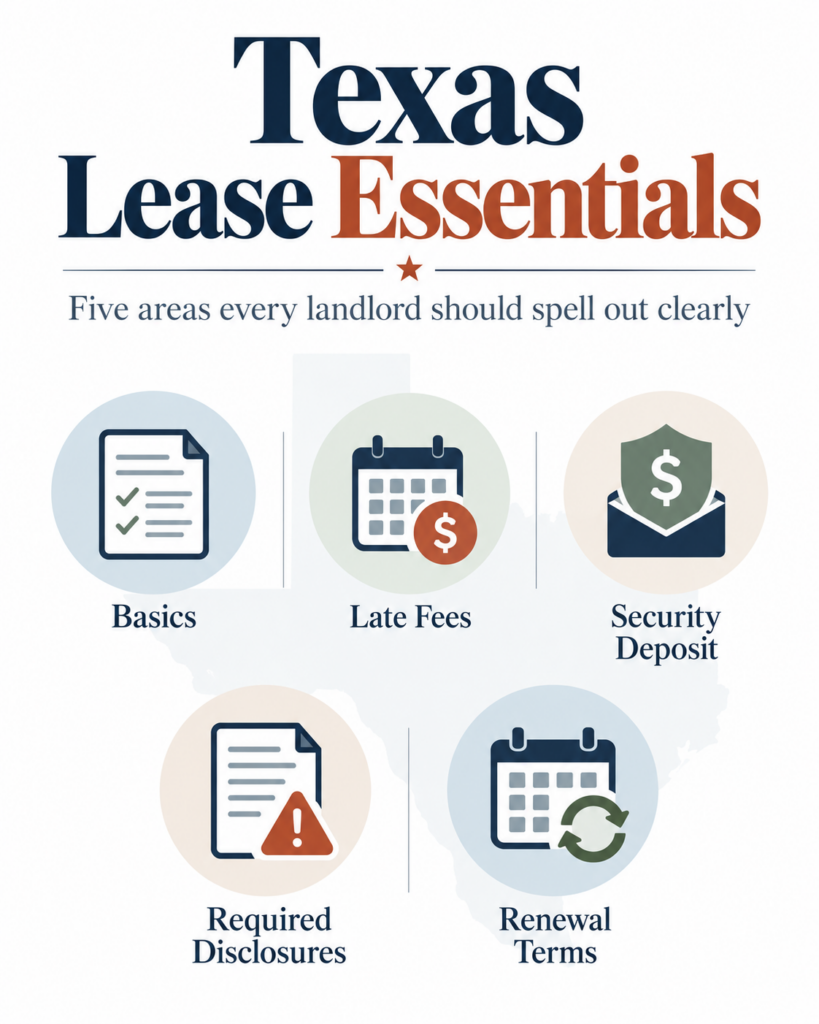
It sounds obvious, but a surprising number of lease disputes arise from ambiguity in the most fundamental terms. Your lease should clearly identify the full legal names of all adult tenants who will occupy the property, the complete property address, the exact lease start and end dates, and the monthly rent amount. Do not leave room for interpretation on any of these points.
Specify the rent due date and, critically, the grace period. Texas law requires a minimum two-day grace period before a landlord can charge a late fee, meaning if rent is due on the first, you cannot assess a late fee until after the third . State this clearly in the lease so there is no confusion about when a payment becomes late.
Also be explicit about who is authorized to occupy the property. If you are renting to a couple, both names should be on the lease. If they have children, note that. Unauthorized occupants are a common source of friction, and your lease is the document that defines the boundary.
Late Fees: Know the Cap and Put It in Writing
Texas law allows landlords to charge late fees, but those fees must be “reasonable” and must be specified in the lease, you cannot simply add a late fee after the fact . For properties with four or fewer units (which covers most private family home landlords), the late fee cannot exceed 12 percent of the monthly rent. For properties with five or more units, the cap drops to 10 percent.
Do the math before you write the lease. If you are charging $1,800 per month in rent, your maximum late fee is $216. Some landlords prefer a flat daily fee after the initial late charge; that is permissible, but the total must still stay within the legal cap. Whatever structure you choose, spell it out precisely in the lease. A vague clause like “a late fee will apply” is not enforceable.
Security Deposits: No Cap, But Clear Rules
Unlike many states, Texas does not limit how much a landlord can charge for a security deposit. One to two months’ rent is the most common range for single-family homes, but the amount is ultimately up to you and the market. What Texas law does regulate strictly is what happens to that deposit at the end of the tenancy.
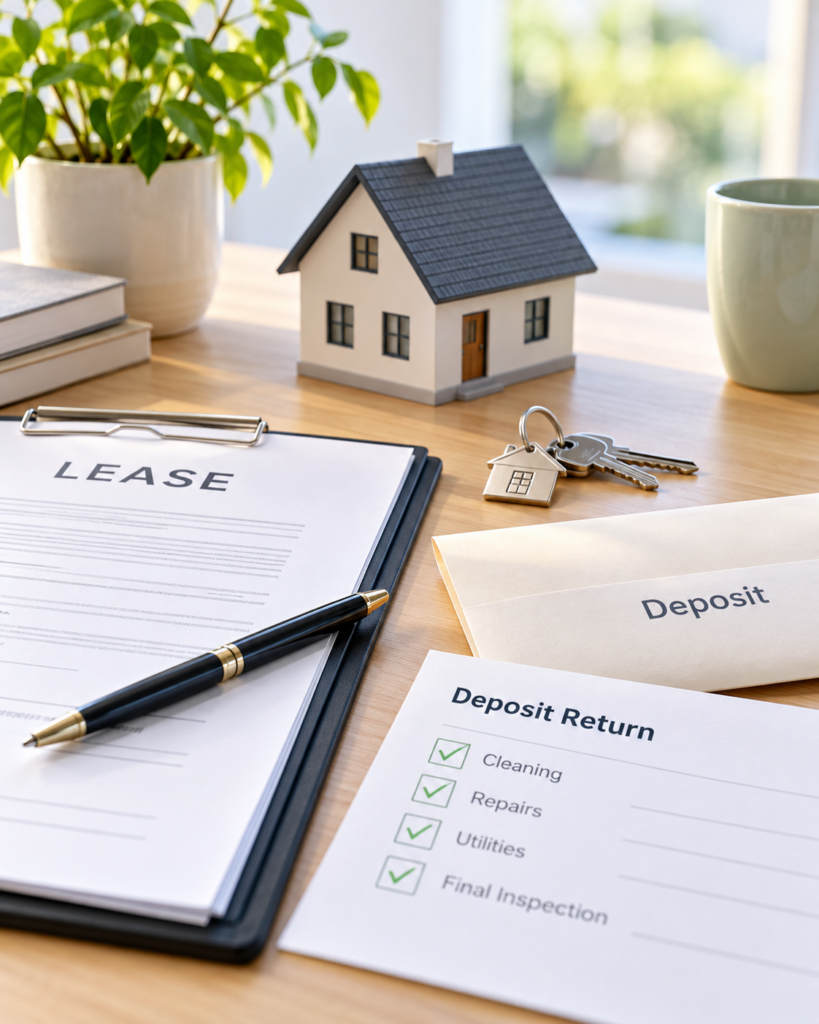
You are required to return the security deposit, minus any lawful deductions, within 30 days of the tenant surrendering the premises . If you withhold any portion, you must provide the tenant with a written, itemized accounting of the deductions. Failing to comply with this timeline can expose you to significant liability: a landlord who retains a deposit in bad faith can be held liable for $100, three times the amount wrongfully withheld, and the tenant’s attorney’s fees.
Your lease should clearly state the deposit amount, the conditions under which deductions may be made, and the requirement that the tenant provide a forwarding address in writing. That last point matters, the 30-day clock does not start until you have the forwarding address.
Required Disclosures: Do Not Skip These
Texas law mandates several disclosures that must be included in or accompany every residential lease. Missing any of them can create legal exposure, so treat this as a checklist.
Flood Disclosure is one of the most important and most frequently overlooked. As of January 1, 2022, all residential leases in Texas must include a flood disclosure indicating whether the landlord is aware of the property being in a 100-year FEMA-designated floodplain and whether flooding has damaged the property at any point during the last five years . Given how many Texas communities have experienced flooding in recent years, from Houston to the Hill Country, this disclosure is not a formality. It is a genuine legal obligation.
Lead-Based Paint Disclosure is required for any property built before 1978. Federal law mandates that landlords distribute an EPA-approved information pamphlet and disclose any known lead hazards. This disclosure must be signed by the tenant and kept on file.
Landlord/Agent Identity must be disclosed in writing. Texas Property Code Section 92.003 requires landlords to provide the name and contact information of the property owner or authorized agent who manages the property and collects rent . This can be included directly in the lease.
Tenant Remedies regarding repairs must also be disclosed. Texas law gives tenants the right to seek remedies if a landlord fails to make required repairs, and landlords are required to inform tenants of this right.
“I can’t tell you how many times I’ve seen new landlord clients come to me after a dispute, only to find that the root of the problem was a self-written lease missing a required disclosure or containing language that simply wouldn’t hold up,” says Erika Navarro, a licensed Texas Realtor in the Greater Houston area.
“The flood disclosure, in particular, has become a major issue since the 2022 requirement went into effect. If you’re not including it, you’re leaving yourself exposed. A well-written lease isn’t just about protecting yourself; it’s about being transparent with your tenant from day one. That transparency often leads to better tenancies.”
Pet Policy, Parking, and Other Specific Terms
The Texas Property Code does not extensively regulate what landlords can and cannot include in a lease beyond the rights that cannot be waived. This means you have considerable latitude to set the terms that matter to your property — but those terms need to be written down.
If you allow pets, specify the types and sizes permitted, the pet deposit amount (note that this is separate from the security deposit), and any rules about where pets are allowed on the property. If you do not allow pets, say so explicitly. A vague lease that does not address pets at all leaves you with no legal footing if a tenant moves in a dog.
Parking rules, guest policies, lawn maintenance responsibilities, and rules about subletting should all be addressed. For single-family homes in Texas, it is particularly common for landlords and tenants to disagree about who is responsible for lawn care and minor maintenance. Put it in writing. If the tenant is responsible for mowing, say so. If you are providing a lawnmower, note that too.
Lease Term and Renewal: Be Clear About What Happens Next
Most Texas residential leases are written as one-year fixed-term agreements. At the end of that term, the lease either renews, converts to a month-to-month arrangement, or terminates — and your lease should specify which of those outcomes applies by default.
If the lease converts to month-to-month, Texas law requires at least 30 days’ written notice from either party to terminate . If you intend to offer a renewal at a different rent amount, specify in the original lease how and when you will communicate that. Giving tenants clarity about what to expect at the end of the lease term reduces friction and helps you avoid the awkward conversation where a tenant assumes they are staying and you assumed they were leaving.
Use a Texas-Specific Lease and Keep It Current
This point cannot be overstated. Generic lease templates from national websites may not reflect the specific requirements of Texas law, and they almost certainly do not include the state-mandated disclosures discussed above. Texas has its own statutory framework, and your lease needs to reflect it.
The Texas Association of Realtors (TAR) produces a widely used residential lease form that is regularly updated to reflect changes in state law. If you are working with a licensed Realtor, they can prepare this lease on your behalf. Several property management platforms, including Go4Rent, which offers free lease writing for Texas properties, also generate Texas-compliant leases with the appropriate addendums built in.
Whatever source you use, make sure the lease is reviewed and updated periodically. Texas law changes, and a lease that was compliant three years ago may be missing a required disclosure today. The flood disclosure requirement, for example, only took effect in 2022, which means any lease written before that date and not updated since is already out of compliance.
The Bottom Line
A well-written lease is not about being adversarial with your tenant. It is about being clear. When both parties understand the terms from day one, the rent, the rules, the responsibilities, and the consequences of violations, the tenancy runs more smoothly for everyone involved. Disputes are less likely when there is nothing to dispute.
Take the time to get your lease right before you hand over the keys. In Texas, the law gives you the tools to protect your investment. Use them.