This Content Is Only For Subscribers
Arlington occupies an unusual place in North Texas. It sits almost directly between Dallas and Fort Worth, but it has long since outgrown the idea that it is simply a suburb of either one.
With a 2025 population estimate of 402,134, Arlington is one of the largest cities in Texas. It stretches across nearly 100 square miles of Tarrant County and includes everything from established neighborhoods built decades ago to newer subdivisions, university housing, major employment centers and one of the most recognizable entertainment districts in the country.
That variety creates a rental market with several different personalities.
A house near Lake Arlington may attract a very different tenant from one near the University of Texas at Arlington. North Arlington properties sit close to professional sports, hotels and major entertainment venues, while neighborhoods farther south provide access to Interstate 20, Mansfield, Grand Prairie and employment throughout the southern Metroplex.
For landlords, Arlington’s size is part of the opportunity. There is no single “Arlington renter.” The city draws university students and employees, healthcare workers, manufacturing employees, families, sports and hospitality workers, commuters and people who simply want a central location inside the Dallas-Fort Worth region.
Jobs in Arlington
One of Arlington’s strengths is that residents do not have to leave the city to find major employers.
Education is a significant part of the local economy. Arlington Independent School District is one of the largest employers in the city, and the University of Texas at Arlington has thousands of faculty and staff members in addition to its large student population.
Manufacturing also remains important. General Motors has operated its Arlington Assembly plant since the 1950s, giving the city a major industrial employer that has survived multiple generations of economic change. Healthcare is another substantial employment sector, with Texas Health Resources and other medical providers operating throughout the city. City planning documents identify education, entertainment, finance, government, healthcare, manufacturing and retail among Arlington’s leading employment sectors.
The Entertainment District adds another layer.
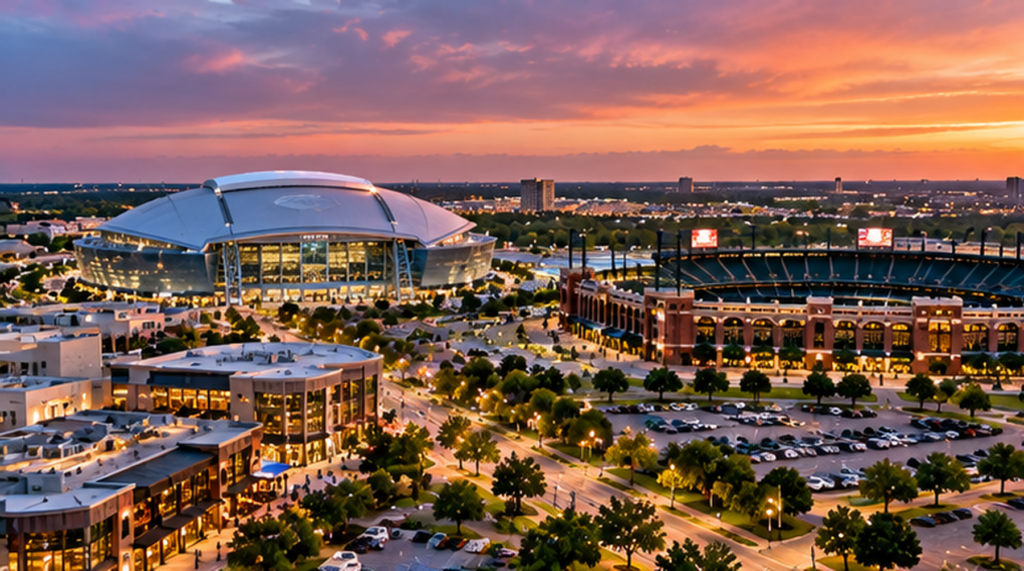
AT&T Stadium, Globe Life Field, Six Flags Over Texas, Hurricane Harbor, Texas Live!, hotels, restaurants and event businesses support thousands of jobs tied to tourism and entertainment. More than 15 million visitors come to Arlington’s Entertainment District each year, according to the city.
That visitor economy received an enormous boost in 2026. Arlington hosted nine matches during the global soccer tournament, including a semifinal, and more than 631,000 fans attended matches at AT&T Stadium during the event.
Arlington also benefits from its central position in the Metroplex. Interstate 30 connects the city toward Fort Worth and Dallas, while Interstate 20 serves southern Arlington. State Highway 360 provides another major north-south route connecting the city with DFW International Airport and employment areas throughout eastern Tarrant County and western Dallas County.
The Census Bureau reports an average commute of about 26.6 minutes for Arlington workers.

Education in Arlington
Most of Arlington is served by Arlington Independent School District, although the city’s boundaries also extend into several other school districts. Arlington is actually served by five independent school districts, so landlords and renters should confirm the assigned schools for a specific address.
Arlington ISD remains a very large district. The district reported nearly 51,000 enrolled students in 2026, with schools ranging from traditional neighborhood campuses to specialized career, early-college and technical programs.
The district’s size gives families a broad range of programs. Career and technical education is particularly prominent, and Arlington ISD reports that 75% of secondary students participate in CTE programs designed around real-world career fields. The district’s 2025 graduating class included more than 4,100 students.
Higher education is one of Arlington’s biggest distinguishing features.
The University of Texas at Arlington sits just south of downtown and has grown into a major research university. Preliminary fall 2026 enrollment reached 42,787 students, including more than 31,000 undergraduates.
UTA changes the character of central Arlington in ways that smaller suburban cities do not experience. Students, professors, researchers and university employees create demand for housing, restaurants, entertainment and services throughout the surrounding area.
For landlords, properties near UTA can operate in a different rental environment from family-oriented subdivisions elsewhere in the city. Tenant turnover, parking needs, lease timing and bedroom configurations may all matter more around the university than they do in a traditional single-family neighborhood.
Quality of Life in Arlington
Arlington is dense and heavily developed in places, but the city has a surprisingly large park system.
The city reports about 4,600 acres of parkland, more than 80 miles of park trails, multiple recreation centers, golf courses, aquatic facilities and dozens of neighborhood parks.
The best-known natural area is River Legacy Parks in north Arlington. The system follows the Trinity River corridor and provides trails, wooded areas, playgrounds and access to one of the largest undeveloped natural corridors inside the city.
River Legacy Park East alone covers 54 acres and includes hiking and biking trails, playgrounds, volleyball and recreation areas.
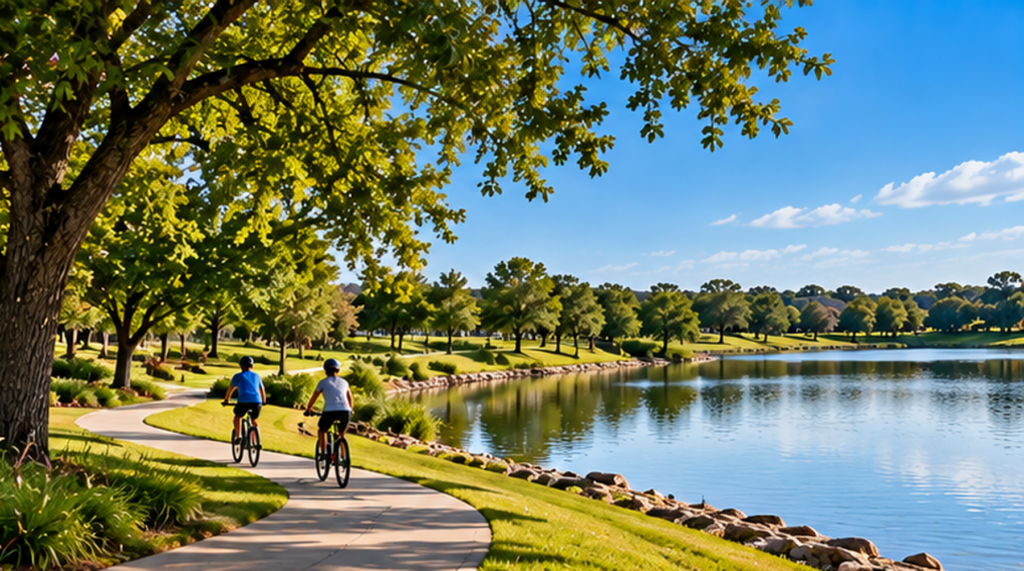
Residents on the southern side of Arlington have another major outdoor resource in Lake Arlington. The lake and surrounding parks provide boating, fishing, paddling and shoreline recreation, and neighborhoods near the lake can feel considerably removed from the stadiums and commercial development several miles north.
Downtown offers a different type of public space. Founders Plaza and the Levitt Pavilion host outdoor events and free concerts throughout much of the year. The pavilion has become one of downtown Arlington’s gathering places, and the surrounding district includes restaurants, the downtown library, Theatre Arlington, Arlington Music Hall and a growing collection of local businesses.
That range is part of Arlington’s appeal. A renter can live near a university, near a wooded trail system, close to Lake Arlington or within a short drive of professional sports without leaving the city limits.
Shopping, Dining and Entertainment in Arlington
Entertainment is the category where Arlington separates itself from almost every other North Texas community.
AT&T Stadium is home to the Dallas Cowboys and hosts college football, concerts and major international events. Across the street, Globe Life Field is home to the Texas Rangers. Texas Live! connects the sports venues with restaurants, bars and entertainment space.
The National Medal of Honor Museum joined the district in March 2025. The museum contains more than 100,000 square feet, including 31,000 square feet of exhibition galleries devoted to Medal of Honor recipients and their stories.
Then there is Six Flags.
Six Flags Over Texas, which opened in 1961, celebrated its 65th season in 2026. The park introduced Tormenta: Rampaging Run during the anniversary year, a 309-foot-tall dive coaster that Six Flags describes as the world’s tallest, fastest and longest giga dive coaster.
Shopping is spread across several sections of the city.

The Parks Mall at Arlington and surrounding Interstate 20 retail provide one of the largest shopping concentrations in southern Arlington. Cooper Street is lined with restaurants and businesses for miles, and additional retail clusters exist around Collins Street, north Arlington and the Entertainment District.
North Arlington is also going through another round of redevelopment. The former Lincoln Square property is being transformed into Anthem, a redesigned district expected to contain about 404,000 square feet of retail, dining, public space and entertainment uses. Construction began in 2026.
Downtown is changing as well. In September 2026, Arlington approved another major mixed-use development around Abram and Mesquite streets that is planned to include at least 390 apartments, office space, restaurants, retail and structured parking.
Those projects are gradually creating more identifiable districts inside a city that historically developed around automobiles and widely separated commercial corridors.
Cost of Living in Arlington
Arlington sits in the middle of the Metroplex geographically, and its housing prices also tend to occupy a middle ground compared with some of North Texas’ more expensive northern suburbs.
The Census Bureau reports a median value of $304,700 for owner-occupied homes based on 2020-2024 data. The city’s owner-occupancy rate was 54.3%, significantly lower than many smaller suburban communities.
That lower ownership rate is important for rental owners. Arlington has a substantial renter population and a much deeper rental market than communities where 75% or 80% of homes are owner occupied.
Median gross rent was $1,470 per month during the same Census period. That figure includes certain utility costs and covers many types of rental housing, so it should not be treated as the current asking rent for a single-family property. It does provide a useful benchmark for comparing Arlington with surrounding cities.
Median household income was $75,171, while per-capita income was $36,148. The Census Bureau reported a poverty rate of 12.9%.
For landlords, neighborhood selection matters considerably.
North Arlington can command attention because of proximity to the Entertainment District, River Legacy and Interstate 30. Central Arlington benefits from UTA, downtown and older established neighborhoods. Southwest Arlington includes larger homes and easy access toward Mansfield. Southeast Arlington places residents closer to State Highway 360, Grand Prairie and employment corridors to the east.
Property age also varies dramatically. Arlington has homes dating back many decades sitting only a few miles from subdivisions built much more recently. A lower purchase price on an older house can come with older plumbing, electrical systems, foundations, roofs or HVAC equipment that deserve careful review before an investor compares it with a newer property.
Other Notable Facts About Arlington
Arlington is celebrating a major anniversary in 2026.
The city traces its founding to July 19, 1876, when Texas and Pacific Railroad Engine No. 20 arrived at the site that became Arlington. The community incorporated in 1884. In 2026, the city marked its 150th anniversary with events and historical programs throughout the year.
The railroad was the reason the town existed in the first place. Arlington grew between Dallas and Fort Worth as an agricultural and trading community before beginning a much more dramatic transformation after World War II.
General Motors opened the Arlington Assembly plant in the 1950s. Six Flags Over Texas followed in 1961. The Texas Rangers moved to Arlington in 1972, and the Dallas Cowboys arrived decades later when AT&T Stadium opened in 2009.
UTA was growing at the same time, helping turn Arlington into a city built around several major economic engines instead of one dominant industry.
That history explains why modern Arlington can feel like several cities sharing the same name.
There is an older downtown and university district. There are quiet postwar neighborhoods shaded by mature trees. There are large subdivisions near Mansfield and Grand Prairie. North Arlington can feel like a tourism and entertainment center on major event weekends, while the River Legacy area only a few minutes away feels wooded and residential.
The city continues to evolve. Downtown redevelopment is adding housing and businesses, the Entertainment District keeps expanding, and UTA continues to bring tens of thousands of students into the center of the city.
For rental owners, Arlington offers something that many smaller suburban markets cannot: a large and diverse base of potential tenants combined with several independent sources of employment and demand.
The property still has to make sense on its own. Street, school assignment, commute, age, condition and nearby competition can change the equation quickly in a city this large.
But Arlington’s central location, deep employment base, university presence and enormous entertainment economy give landlords plenty of reasons to keep it on the North Texas map.