
A good Texas landlord does not need to turn every conversation into a legal memo. But there are plenty of moments when a quick verbal agreement is not enough. The practical question is not whether every message must be formal. It is whether the subject could affect money, access to the property, a lease obligation, a repair dispute, or the status of the tenancy. When the answer is yes, a written record is usually worth the extra minute.
That matters for landlords across DFW and North Texas because many day to day issues start casually. A tenant in Frisco calls about an air conditioner in August. A roofer needs access in Plano after a hailstorm. A tenant in Arlington asks to pay part of the rent now and the balance next Friday. None of those conversations need to become confrontational. They do need to be documented correctly.

Start With What the Lease and the Law Actually Require
Some communications have specific legal or lease requirements. Others do not. The safest habit is to separate those two categories instead of assuming that every text message has the same legal effect.
For example, a written lease may require certain notices to be in writing or delivered through a particular method. Formal notices can also have statutory requirements. A Notice to Vacate is not the same thing as an ordinary maintenance update, and a casual text should not be treated as a substitute for a notice that the lease or Texas law requires to be delivered in a particular way.
Lease Changes and Financial Accommodations
Changes to the lease should be documented carefully. If you allow a pet that was not originally approved, permit a tenant to make an alteration, change a parking arrangement, or agree to another exception, put the terms in writing. Many leases contain language requiring modifications to be written and signed. Even when an oral conversation later becomes evidence of waiver, reliance, or the parties’ conduct, that is exactly the kind of dispute a written agreement can prevent.
The same rule applies to money. If a tenant asks for a payment plan, a late fee waiver, or permission to make a partial payment, write down the amount, the dates, what is being waived, and what is not changing. Do not rely on a phone call from memory. A short written payment agreement is easier to enforce and easier for both sides to understand.
Repairs Deserve a Written Trail
Texas repair law is more nuanced than simply saying every repair request must always be written. A written lease may require the tenant to give repair notice in writing. Texas Property Code Sections 92.052 and 92.056 also contain specific notice rules that can affect the remedies available to a tenant, including circumstances in which a later written notice may be required unless the first notice was sent by a trackable delivery method.
From the landlord’s side, the best operating practice is still simple. Accept the problem, get it into writing, acknowledge it, document the vendor request, and keep the tenant updated. If an air conditioner fails during a North Texas heat wave, a roof starts leaking after hail and wind, or a pipe problem appears after a hard freeze, the legal question is not improved by a missing paper trail.
Entry, Violations, and Deadlines
Property access is another area where written follow up helps. Texas does not impose one statewide notice period for every nonemergency entry. The lease is important. If you schedule an HVAC technician, plumber, pest control company, or inspection, give the tenant clear written information about the date, the expected time window, the reason for entry, and who will be entering.
Lease violations, nonrenewal notices, and other deadlines should also be handled with care. If you discuss a problem by phone, follow up in writing so the tenant knows what the issue is and what the lease requires next. Do not assume that a friendly conversation replaces a formal notice when a formal notice is required.
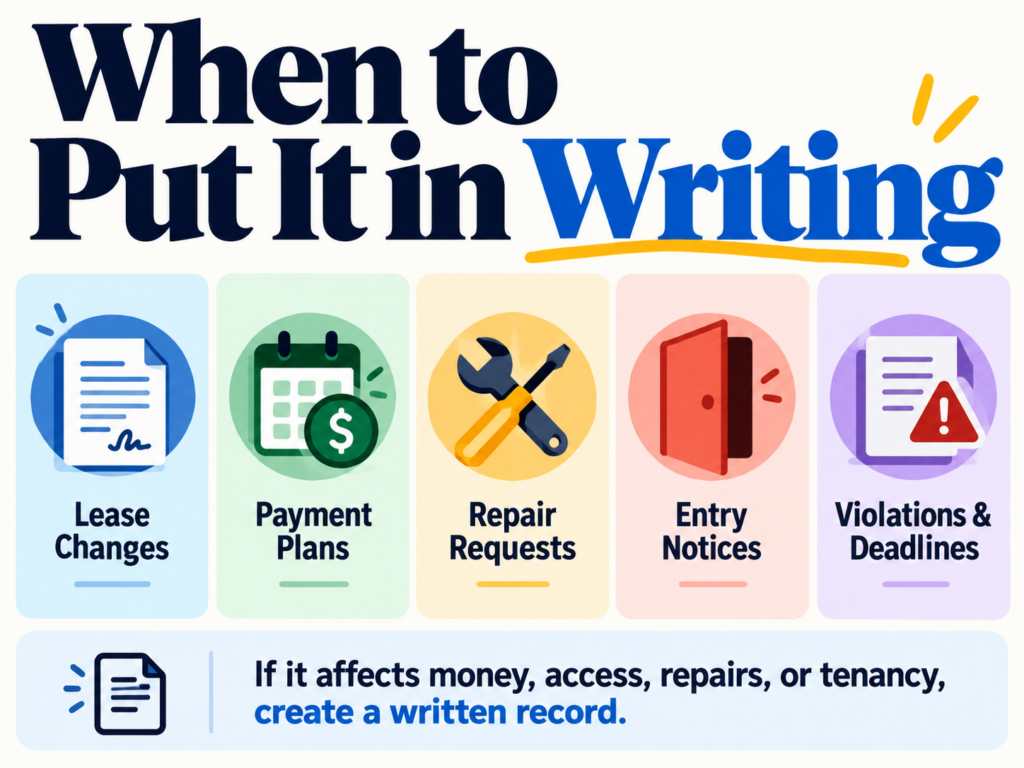
A Simple Rule That Works
You do not need to write down every hello, scheduling question, or routine courtesy. Focus on the conversations that could later change the answer to a legal or financial question. If someone might eventually ask what was agreed, when notice was given, whether permission was granted, or what deadline applied, create a record while the facts are still fresh.
For a small landlord, that can be as simple as an email, a portal message, or another written method allowed by the lease and appropriate for the situation. The goal is not paperwork for its own sake. The goal is to make sure that six months later, neither side has to rely on memory to explain what happened.