
This Content Is Only For Subscribers
Welcome back to Landlord Legal Lowdown. This month we are looking at one of the least dramatic parts of property management and one of the easiest places to create a legal problem: communication.
A landlord can have a solid lease, a well maintained house, and a good tenant, then still create unnecessary risk with a vague entry message, an undocumented payment arrangement, or a formal notice sent the wrong way. The lesson is not that every tenant conversation needs to sound like it came from a lawyer. The lesson is that different communications have different legal jobs.
For landlords across DFW and North Texas, that distinction matters in very ordinary situations. An HVAC company is trying to get into a house during a hot week. A tenant in Frisco reports a roof leak after hail. A renter in Arlington wants a short payment arrangement. A severe storm damages a fence and the insurance adjuster needs access. Each situation involves communication, but the rules are not identical.

Start by Separating Law, Lease, and Good Practice
One of the easiest mistakes in landlord advice is turning a good practice into a supposed Texas law. Those are not the same thing. Texas statutes control some notices. The lease controls many other details. Then there are practices that are simply smart because they reduce misunderstandings.
A landlord should know which category applies before acting. A friendly email may be excellent documentation for a vendor appointment. It may not be the correct method for a formal notice if the statute or lease requires something else. On the other hand, a routine entry request should not be treated as though Texas has a universal 24 hour statute when it does not.
Entry: Read the Lease Before You Quote a Rule
Texas does not set one statewide number of hours that applies to every nonemergency landlord entry. Residential leases commonly address when the landlord may enter and what contact or notice is expected. That makes the lease the starting point.
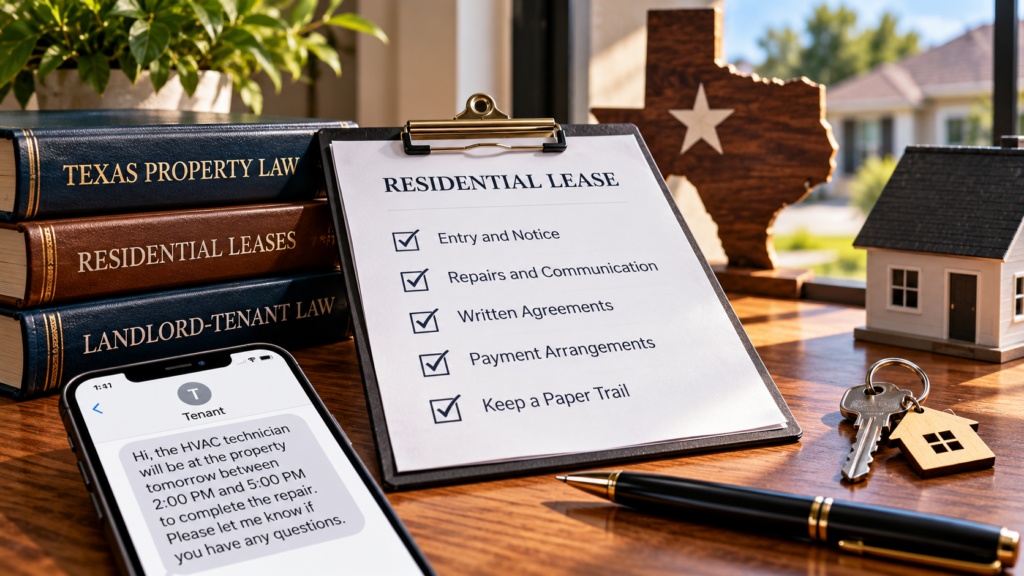
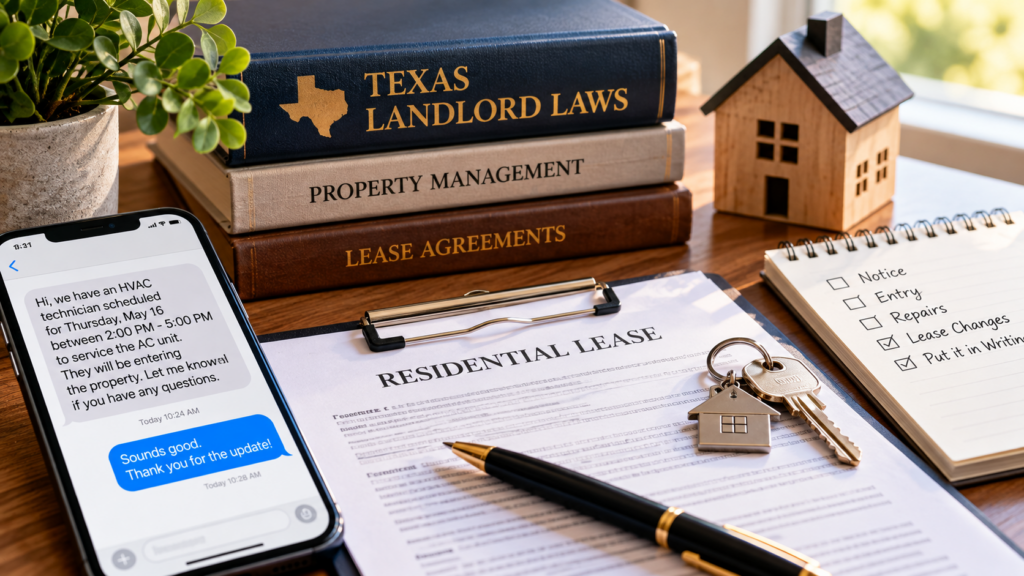
For routine entry, a written message with useful advance notice is usually good property management. State the date, a reasonable time window, the purpose, and who is entering. If a Dallas HVAC technician is scheduled between 2 PM and 5 PM, say exactly that. If a roofer, plumber, or fence contractor will enter while the tenant is away, identify the company and follow the access procedure in the lease.
Emergencies are different. An active leak, fire, or another condition requiring immediate action may justify a faster response. Even then, document why the entry happened and what was found. Do not label an ordinary inspection an emergency just because advance scheduling is inconvenient.
If a tenant refuses entry, do not make the dispute worse by improvising. Check the lease, document the refusal, explain the legitimate purpose, and reschedule if reasonable. Continued refusal may create a lease enforcement issue, but the facts and the lease matter.
Repair Notices: The Statute Is More Detailed Than Most Summaries
Texas repair law is frequently oversimplified. Section 92.052 addresses the landlord’s duty to repair conditions that materially affect the physical health or safety of an ordinary tenant, subject to statutory conditions. A written lease may require the tenant to give repair notice in writing.
Section 92.056 contains additional notice requirements for certain tenant remedies. Depending on how the first notice was delivered, a subsequent written notice may be required after a reasonable time unless the first notice was sent by certified mail, registered mail, or another trackable delivery method described by the statute. The law also uses a reasonable time standard, with seven days serving as a rebuttable presumption in the statutory analysis, not an automatic deadline for every repair.
The practical landlord response should be faster than a legal argument whenever possible. If an air conditioner stops working during a North Texas heat wave, a roof leaks after hail, or a pipe problem appears after a hard freeze, acknowledge the request, contact a qualified vendor, document the appointment, and update the tenant if parts, weather, or scheduling cause delay. Do not tell yourself that a technical notice issue is a reason to ignore a real property problem.
Consent and Lease Changes Should Not Live in Memory
Many disputes begin with an exception that seemed harmless at the time. A tenant asks to add a pet. You agree to let them install something on the property. You allow a different parking arrangement. You accept a partial payment and give the tenant another week.
Put those agreements in writing. The lease may require modifications to be written and signed. Even when the parties later argue about waiver, oral modification, reliance, or course of conduct, a clear written agreement is the simplest way to show what was actually approved.
Financial accommodations deserve special care. A payment plan should identify the amounts and dates, explain any fee waiver, and state whether the arrangement changes future obligations. If eviction is already under consideration, accepting money or changing terms without understanding the effect can complicate the case. That is a point where legal advice may be cheaper than guessing.
Security Deposits: Dates and Documentation Matter
Texas security deposit law is another area where small details matter. Under Section 92.103, a landlord generally must refund the security deposit on or before the 30th day after the tenant surrenders the premises, subject to the forwarding address rule in Section 92.107. The landlord is not obligated to return the deposit or provide the written description of deductions until the tenant gives a written forwarding address, but the tenant does not forfeit the deposit merely by failing to provide one.
If deductions are taken, Section 92.104 generally requires a written description and itemized list along with any remaining balance, subject to the statute’s exceptions. Normal wear and tear cannot simply be charged as damage. Photographs, invoices, condition records, and clear descriptions are not magic words, but they make a deduction much easier to explain if it is challenged.
Bad faith handling can be expensive. Section 92.109 provides remedies that can include $100, three times the portion wrongfully withheld, and reasonable attorney fees in a qualifying case. That is a good reason to calendar the move out process rather than relying on memory.
Formal Eviction Notices Changed in 2026
Landlords should be especially careful with older forms and online articles about Notices to Vacate because Texas changed Section 24.005 effective January 1, 2026. The current statute still uses written pre suit notice in specified eviction situations, and the lease can affect the notice period.
Current Section 24.005 provides several delivery methods for a notice required by that section, including mail, delivery inside the premises in a conspicuous place, hand delivery to a tenant who is at least 16 years old, and electronic communication when the parties agreed in writing to that method. The statute also addresses actual receipt. That is materially different from older summaries that focused on the former outside door procedure.
Do not serve an eviction notice from memory. Check the current statute, the lease, and the reason for the eviction. Nonpayment cases also have current rules about when the notice must be a notice to pay rent or vacate. A landlord using an old template can create a problem before the case is ever filed.
Build a Paper Trail You Can Actually Maintain
Good legal records do not require a complicated system. Keep one property folder and one clear tenant record. Save the lease, amendments, repair requests, vendor updates, entry messages, payment agreements, violation notices, move in and move out documentation, security deposit records, and proof associated with formal notices.
For many ordinary contract disputes, four years after the tenancy ends is a useful practical retention baseline, but it is not a universal destruction rule. Tax records, property basis documents, insurance claims, federal lead records for covered housing, warranties, and unresolved disputes can require different treatment. Keep the categories separate and retain longer when another rule or practical need applies.
The best paper trail is not the one with the most pages. It is the one that lets you answer basic questions quickly: What did the tenant report? What did I say? What did we agree to? When was notice delivered? What did the vendor do? What money was charged and why?
DFW and North Texas landlords also need to remember that statewide landlord tenant law is only part of the operating picture. A property may be subject to HOA rules, municipal requirements, insurance conditions, utility procedures, gated community access rules, or storm related repair requirements that affect how a particular issue is handled. Those local or contractual requirements do not replace the Texas Property Code, and they should not be presented to a tenant as though they do. Keep the sources separate. If a roof inspection is required after hail, say that. If a gated neighborhood requires vendor clearance, say that. If the lease controls access, point back to the lease. Clear communication gets easier when the landlord can explain not only what is being requested, but also where the requirement comes from.
Communication Is Part of Compliance
Legal Lowdown is not about turning landlords into lawyers. It is about recognizing the moments when ordinary property management crosses into legal process. Use the lease. Use the current statute. Put important agreements in writing. Keep proof of what happened. And when the next step could end a tenancy or create a significant claim, get advice before improvising.
That distinction also makes the record easier for a judge, attorney, manager, or future owner to understand later.
Until next time, keep the messages clear, keep the records organized, and make sure the paper trail matches what actually happened at the property.