Home Blog Page 11

The Landlord’s Guide to Tenant Screening: Finding the Right Fit for Your Rental Property

As a private family home landlord, you know that finding the right tenant is about more than just filling a vacancy. It is about protecting your investment, ensuring a steady stream of rental income, and maintaining peace of mind. The rental industry around the nation is booming, and with a steady influx of new residents, the rental market is as competitive as ever. But a larger pool of applicants does not necessarily make selection easier. In fact, it makes rigorous tenant screening more critical than ever.

The cost of a bad tenant can be staggering. Beyond the immediate loss of rental income, you could face property damage, legal fees, and the emotional toll of a lengthy eviction process. Fortunately, technology has leveled the playing field, offering independent landlords access to powerful screening tools that were once the exclusive domain of large property management firms.

In this guide, we will walk through six popular tenant screening platforms, RentSpree, Rental Beast, Cozy (now Apartments.com Rental Manager), MySmartMove, Zillow Rental Manager, and Go4Rent, and help you understand what each one brings to the table. Every platform has genuine strengths, and the right choice ultimately depends on how you prefer to manage your rental business.

Why Tenant Screening Matters

Real Estate law is generally considered landlord-friendly, but that does not mean you want to test the eviction process if you can avoid it. A thorough screening process is your first line of defense. At minimum, a solid screening should cover:

Credit history gives you a window into an applicant’s financial responsibility, existing debt load, and payment patterns. Criminal background checks are essential for protecting your property and the surrounding neighborhood. Eviction history is widely regarded as the single strongest predictor of future rental behavior. Employment and income verification confirms that the applicant has the financial means to pay rent consistently. And rental history verification, ideally involving direct contact with previous landlords, reveals how an applicant actually behaves as a tenant, not just on paper.

Relying on a gut feeling or a quick glance at a pay stub is a recipe for trouble. Let’s look at how the major screening platforms handle these critical checks.

RentSpree

RentSpree has built a strong reputation among real estate agents and independent landlords for its clean, modern interface and seamless integration with MLS platforms. It is one of the most widely used screening tools in the country and has earned strong reviews for ease of use.

The platform delivers a detailed TransUnion credit report, a comprehensive criminal background check, and a nationwide eviction history report. A bank-verified income report powered by Finicity, a Mastercard company, rounds out the core screening package. Landlords can use the platform for free, while applicants pay $39.99 for the standard screening package. The entire process is initiated with a single shareable link, making it quick and painless for both parties.

“I listed my home in Plano and had six applicants within a week,” says Jennifer M., a first-time landlord in the Dallas-Fort Worth area. “RentSpree made it incredibly easy to send out screening links and get reports back fast. I had everything I needed to make a decision within a day.”

Where RentSpree shines is in speed and simplicity. If you are comfortable reviewing automated reports and doing your own follow-up on employment and rental references, it is a highly capable tool. The platform does not, however, include built-in manual verification services, so that legwork remains yours to do.

Rental Beast

Rental Beast takes a slightly broader approach, positioning itself as a full-service platform for real estate professionals. It is the exclusive recommended rental software provider of the National Association of REALTORS®, which speaks to its credibility in the industry.

Their “Apply Now” screening feature includes a detailed TransUnion credit report and score, eviction-related proceedings, and criminal background checks where available. The platform is free for landlords and agents, with applicants paying a fee that typically ranges from $20 to $49 depending on the market. Rental Beast also offers listing syndication across a network of rental sites, which can be a significant advantage when you are trying to fill a vacancy quickly.

Rental Beast is a strong choice if you want your listing to get maximum exposure while simultaneously screening applicants through a trusted, FCRA-compliant process. Like RentSpree, the screening is primarily automated, which means employment and rental history verification is left to the landlord.

Cozy (Now Apartments.com Rental Manager)

For years, Cozy was one of the most beloved tools among small independent landlords. It offered free rent collection, easy online applications, and simple tenant screening, all in one place. In 2018, CoStar Group acquired Cozy and eventually migrated all accounts into the Apartments.com Rental Manager platform.

Today, landlords can access credit, background, and eviction reports powered by TransUnion’s ResidentScore, a scoring model designed specifically for rental decisions rather than general creditworthiness. The platform retains many of the features that made Cozy popular, including rent collection and listing management. Applicants typically pay around $29 for the screening package.

The Apartments.com platform is a reliable, no-frills option that works well for landlords who want a familiar, integrated experience for both listing and screening. The screening itself is fully automated, and like most platforms in this space, it does not include manual verification of employment or rental references.

Credit Report with Score rating app on smartphone screen showing creditworthiness of a person for loan and mortgage application based on payment history and debt usage, budget management performance. High quality photo

MySmartMove (TransUnion)

MySmartMove is TransUnion’s own direct-to-consumer screening product, and its biggest selling point is exactly that—the data comes straight from one of the three major credit bureaus, with no middleman involved.

The platform offers tiered pricing: Basic ($25), Plus ($40), and Premium ($48), with each tier adding more depth to the report. The Premium package includes TransUnion’s “Income Insights” tool, which analyzes an applicant’s credit behavior to estimate whether their self-reported income is likely accurate. Because applicants initiate the screening themselves, landlords never handle sensitive personal information like Social Security numbers, which is a meaningful privacy and compliance advantage.

MySmartMove is an excellent choice for landlords who prioritize data accuracy and privacy compliance. It is worth noting, however, that “Income Insights” is an analytical estimate, not a confirmed verification. It does not involve anyone calling an employer or a previous landlord, so those steps still fall to you.

Zillow Rental Manager

Zillow has transformed from a simple listing site into a powerhouse for end-to-end rental management. Because so many renters begin their search on Zillow, its integrated screening tool offers unparalleled convenience.

For a flat fee of $35 paid by the applicant, Zillow provides a credit report powered by Experian and a criminal background and eviction check through CIC. The major advantage for applicants is that their $35 fee allows them to apply to an unlimited number of participating rentals on Zillow for 30 days. For landlords, the platform is completely free and centralizes leads, applications, and screening reports in a single, mobile-friendly dashboard.

While Zillow offers incredible speed and convenience, landlords should be aware that the background checks rely on national databases. Because some Texas counties are slow to digitize their records, a national search might miss a very recent local filing. Furthermore, Zillow does not conduct manual phone calls to verify employment or previous landlords, meaning you must still perform those critical checks yourself to prevent document fraud.

Go4Rent

Go4Rent takes a different approach from the other platforms on this list, blending the speed of automated data pulls with the thoroughness of human verification. Built specifically for the rental market, it has developed a loyal following among both private landlords and Realtors across the state.

Like the others, Go4Rent provides instant access to credit reports with scores, criminal background checks, sex offender registry checks, and nationwide eviction reports. But the platform’s distinguishing feature is what happens after those instant reports come in. Go4Rent performs manual verifications for both employment and rental history, with processors actually calling employers and current or previous landlords directly. This process typically takes two to three business days, but it fills the gap that every automated platform leaves open.

“I had an applicant with a great credit score, but something felt off,” says Maria C., a landlord in the Woodlands area north of Houston. “With Go4Rent, the processor called the employer and found out the applicant had quit his job the day before applying. That one phone call saved me from a very bad situation.”

Beyond screening, Go4Rent offers free lease writing for rental properties, specifically utilizing the official state lease form. This ensures your lease is fully compliant with current state property codes. Once an applicant is approved, the platform generates the state-approved documents and ensures all parties receive a fully executed copy with e-signatures—a genuine time-saver for landlords who want ironclad legal protection without hiring an attorney.

For landlords who want the full protection of professional management without the uncertainty that often comes with it, Go4Rent offers an Elite property management plan that is worth understanding. Go4Rent manages the property and guarantees rent payment for all twelve months of the lease term. That guarantee does not come with exceptions for non-payment or early departure. If a tenant breaks the lease or is evicted, Go4Rent covers the lost rent and re-leases the home, so the landlord’s income stream is protected from the moment the lease is signed to the moment it ends. For a private family home landlord who has lived through the financial and emotional cost of a bad tenancy, that kind of certainty is difficult to put a price on.

Choosing the Right Platform for You

The right platform depends on how you prefer to run your rental business and how much risk you are comfortable carrying.

If speed and simplicity are your top priorities, RentSpree, MySmartMove, and Zillow Rental Manager are all excellent tools that deliver reliable automated data quickly. If you want maximum listing exposure alongside your screening, Rental Beast is hard to beat. If you are a longtime Cozy user who values an all-in-one experience for screening and rent collection, Apartments.com Rental Manager offers a familiar workflow.

If, on the other hand, you want the most thorough picture of an applicant—one that goes beyond what any algorithm can provide—and you want the added security of a rent guarantee and official state lease forms, Go4Rent offers a level of depth and protection that the other platforms simply do not match. The two-to-three day wait for manual verifications is a small price to pay for the confidence that someone has actually confirmed your applicant’s employment and called their previous landlord.

For private family home landlords, where a single bad tenant can mean months of lost income and significant legal costs, that extra layer of human verification and state-specific legal compliance may well be the most important investment you make in your rental business.

Is a Property Manager Worth It? What Private Landlords Need to Know

Owning a rental home can be one of the most rewarding financial decisions you ever make. It can also be one of the most demanding. Between finding qualified tenants, collecting rent, handling maintenance calls at inconvenient hours, navigating lease renewals, and staying current on landlord-tenant requirements, the responsibilities pile up quickly. For many private family home landlords, the question is not whether they can manage their property themselves. It is whether they should.

Property management companies exist to answer that question with a clear value proposition: hand us the keys, and we will handle the rest. But understanding what that actually means, what you are paying for, what you are getting, and whether it is the right fit for your situation, requires a closer look at how these organizations work.

What Property Management Companies Actually Do

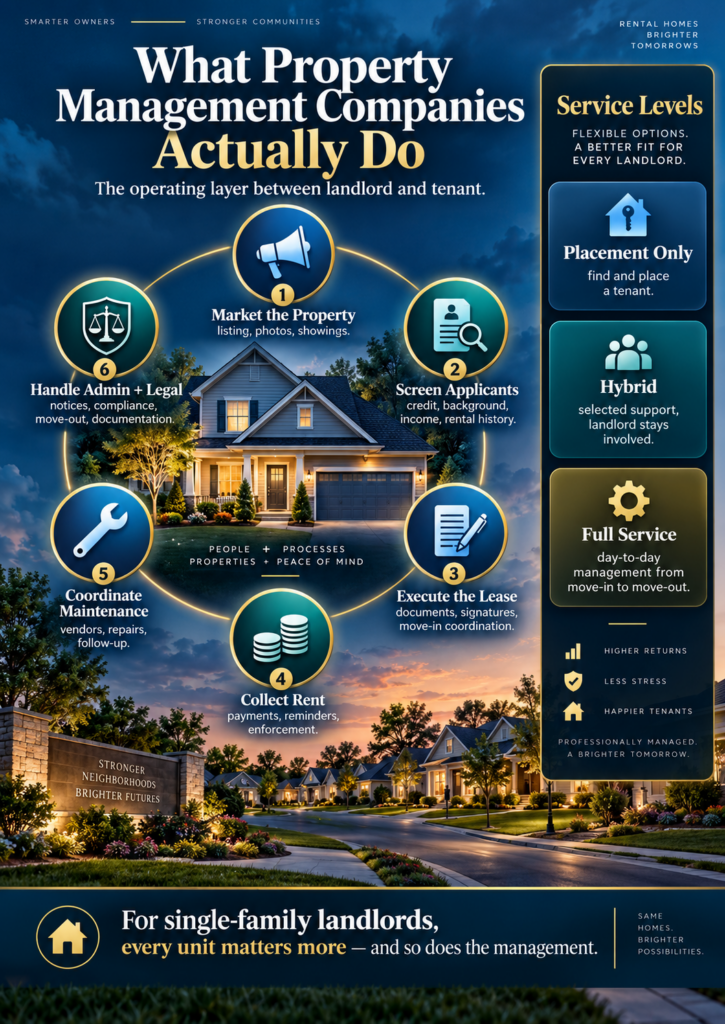
A residential property management company acts as the operating layer between you and your tenant. At its most basic, the job involves marketing the property, screening applicants, executing the lease, collecting rent, coordinating maintenance and repairs, and handling the legal and administrative side of the tenancy from move-in to move-out.

In practice, the scope of services varies considerably from one company to the next. Some firms offer a lean, transactional model where they place a tenant and step back. Others provide full-service management that includes everything from periodic property inspections to handling evictions if things go sideways. Most fall somewhere in between, offering tiered service packages that allow landlords to choose how much involvement they want to retain.

For single-family home landlords specifically, property management is a different animal than apartment management. The tenant relationship in a single-family home tends to be more personal, the maintenance needs more varied, and the financial stakes per unit higher. A good residential property manager understands that your rental home is not just an asset on a spreadsheet. It is likely one of the most significant investments you own, and it deserves to be treated accordingly.

How Property Management Fees Are Structured

Fee structures in the property management industry are not standardized, and the differences between companies can be significant. Understanding what you are agreeing to before you sign a management agreement is essential.

The most common fee is the monthly management fee, which is typically calculated as a percentage of the monthly rent collected. For single-family homes, this often falls between eight and twelve percent, though pricing varies by market and service level. Some companies charge a flat monthly rate instead, which can work in your favor on higher-rent properties. It is worth noting that many reputable companies charge this fee only on rent actually collected, not on rent that was due. If your tenant does not pay, you should understand exactly how the management agreement handles both the fee and the missing rent.

Beyond the monthly fee, most companies charge a leasing or placement fee when a new tenant is placed. This covers the cost of marketing the property, conducting showings, screening applicants, and executing the lease. Leasing fees typically range from half a month’s rent to a full month’s rent, depending on the company and the market. Some companies roll this into a higher monthly fee structure, so it pays to read the fine print.

Other fees you may encounter include lease renewal fees, which compensate the company for negotiating and executing a new lease term with an existing tenant, and maintenance coordination fees, where the company charges a small markup on repair invoices for managing the vendor relationship. Vacancy fees, where a company charges a reduced monthly fee even when the property sits empty, are less common but worth watching for.

The best property management agreements are transparent about every fee upfront and do not bury surprises in the fine print. Before signing with any company, ask for a complete fee schedule and read the termination clause carefully.

What You Actually Get for Your Money

The tangible benefits of professional property management go beyond convenience, though convenience alone is worth something to a landlord who has fielded a 10 p.m. call about a broken water heater.

Tenant screening is one of the most valuable services a property manager provides. A professional company has established processes for pulling credit reports, running criminal background checks, verifying employment and income, and contacting previous landlords. It also has access to screening platforms, identity-verification resources, fraud-detection tools, and established verification procedures that many private landlords do not keep on hand. Property managers have seen enough applications to recognize warning signs that a first-time landlord might miss, and they have the tools to verify what applicants claim rather than simply taking documents at face value.

Rent collection and enforcement is another area where professional management earns its fee. A property manager enforces lease terms consistently and without the emotional complications that can arise when a landlord has a personal relationship with their tenant. The management company also serves as a buffer when a tenant becomes demanding, annoying, confrontational, or openly hostile. Instead of the landlord being pulled into an emotional argument, the manager keeps the conversation focused on the lease, the facts, and the next required step. When rent is late, the process starts immediately. When a tenant violates the lease, the response is measured, documented, and legally defensible.

Maintenance coordination is a significant time saver. Property managers maintain networks of licensed, insured vendors and typically negotiate preferred pricing based on the volume of work they send. For a private landlord managing a single home, finding a reliable plumber or HVAC technician on short notice can be a project in itself. For a property manager, it is a phone call.

Legal compliance is perhaps the least visible but most important benefit. Landlord-tenant laws can impose specific requirements around security deposit handling, notice periods, habitability standards, lease language, and the eviction process. A property manager who stays current on the rules that apply to the property can help protect you from procedural mistakes that turn a straightforward issue into a prolonged dispute.

Go4Rent: A Broader Property Management Option Worth Knowing

Go4Rent occupies an interesting space in the rental market. Rather than functioning only as a traditional property management company, it combines tenant screening, lease execution, payment support, and full-service property management in one platform. That combination gives private landlords access to a more complete process without forcing them to piece together separate vendors for every stage of the tenancy.

Where Go4Rent distinguishes itself is in the human element of its screening process. After running the standard automated checks for credit, criminal history, and eviction records, Go4Rent’s processors manually verify employment and rental history by actually calling employers and previous landlords directly. This is the step that catches the fraudulent pay stubs, the coached references, and the applicants whose paperwork looks perfect but whose history tells a different story.

Go4Rent also provides professionally prepared, state-specific lease documents designed around the requirements that apply where the property is located. The platform handles e-signatures and delivers fully executed copies to all parties, which means the landlord is not drafting lease language alone or relying on a generic form that may overlook important local requirements.

For landlords who want the full protection of professional management without the uncertainty that often comes with it, Go4Rent offers an Elite property management plan that is worth understanding. Go4Rent manages the property and guarantees the landlord’s rent payment for all twelve months of the lease term. The guaranteed payment is the centerpiece of the plan. The landlord receives the rent on time even if the tenant pays late, stops paying, breaks the lease, or must be evicted. Go4Rent continues paying the landlord while handling the problem and working to re-lease the home, protecting the owner’s income stream from the beginning of the lease through the end of the term. Eric F., a property manager with Go4Rent, says “the value goes beyond placing a tenant because it also means keeping the rent predictable, communication professional, and the lease managed all the way through renewal”. For a private family home landlord who has lived through the financial and emotional cost of a bad tenancy, dependable monthly income can be more valuable than simply saving a few percentage points on management fees.

Best Practices from the Property Management Industry

Professional property management companies have refined their processes over years of experience, and the best practices they follow are worth adopting regardless of whether you hire a manager or go it alone.

Thorough tenant screening is the foundation of everything. The most experienced property managers will tell you that a vacancy is almost always preferable to the wrong tenant. Taking the time to verify every claim on an application, contact previous landlords directly, and independently source employer contact information rather than calling the number the applicant provides is the standard that separates good placements from costly mistakes.

Consistent lease enforcement matters more than most landlords realize. When a lease term is enforced selectively, it creates ambiguity about what the rules actually are and makes it harder to enforce them later. Professional managers apply lease terms uniformly and document every communication with tenants in writing, which protects both parties and creates a clear record if a dispute arises.

Regular property inspections, typically conducted once or twice a year with proper notice to the tenant, allow a property manager to catch deferred maintenance before it becomes a major repair and to verify that the property is being cared for appropriately. Many private landlords skip this step entirely and are unpleasantly surprised when a tenant moves out.

Keeping a maintenance reserve and responding to repair requests promptly protects the physical condition of the property and the landlord-tenant relationship. Tenants who feel their maintenance concerns are ignored are more likely to withhold rent, cause additional damage, or simply leave at the end of their lease term. Prompt, professional maintenance response is one of the most effective retention tools available.

Property Management vs. Self-Management: Weighing the Decision

The decision to hire a property manager or manage your own rental home comes down to a straightforward trade-off between cost and time, with a few less obvious factors worth considering.

The case for professional property management rests on expertise, time savings, and risk reduction. A professional manager brings established screening processes, vendor relationships, legal knowledge, and emotional distance to the job. For landlords who own multiple properties, live far from their rental, travel frequently, or simply do not want the phone to ring on a Saturday night, the management fee is a reasonable cost of doing business. The consistency of professional enforcement also tends to produce better tenant retention and fewer legal complications over time.

The case for self-management is primarily financial. Eliminating the management fee and the leasing fee represents real money, particularly on a single-family home where the margins matter. Landlords who are local, handy, and willing to invest the time in learning the legal requirements that apply to their property can manage effectively. The key word is willing. Self-management done poorly is more expensive than professional management done well.

The honest middle ground is that most private landlords underestimate the time and expertise that effective property management requires, and most property managers underestimate how much a landlord values staying connected to their own investment. The best outcome is often a hybrid approach: using professional screening services and legally sound lease documents while retaining day-to-day management, or engaging a full-service manager for the first two years before deciding whether to take over. A two-year period gives the landlord a chance to see more than the initial placement and maintenance cycle. It also shows how the company handles a lease renewal, evaluates the market rent, communicates an increase, negotiates with the tenant, documents the extension, and prepares for either retention or turnover.

Whatever you decide, the goal is the same. A qualified tenant, a well-maintained property, and a lease that protects everyone involved.

This article is intended for informational purposes. Landlords are encouraged to consult a licensed attorney or licensed property manager for guidance specific to their property and jurisdiction.

Getting Paid: A Landlord’s Guide to Rent Collection Methods

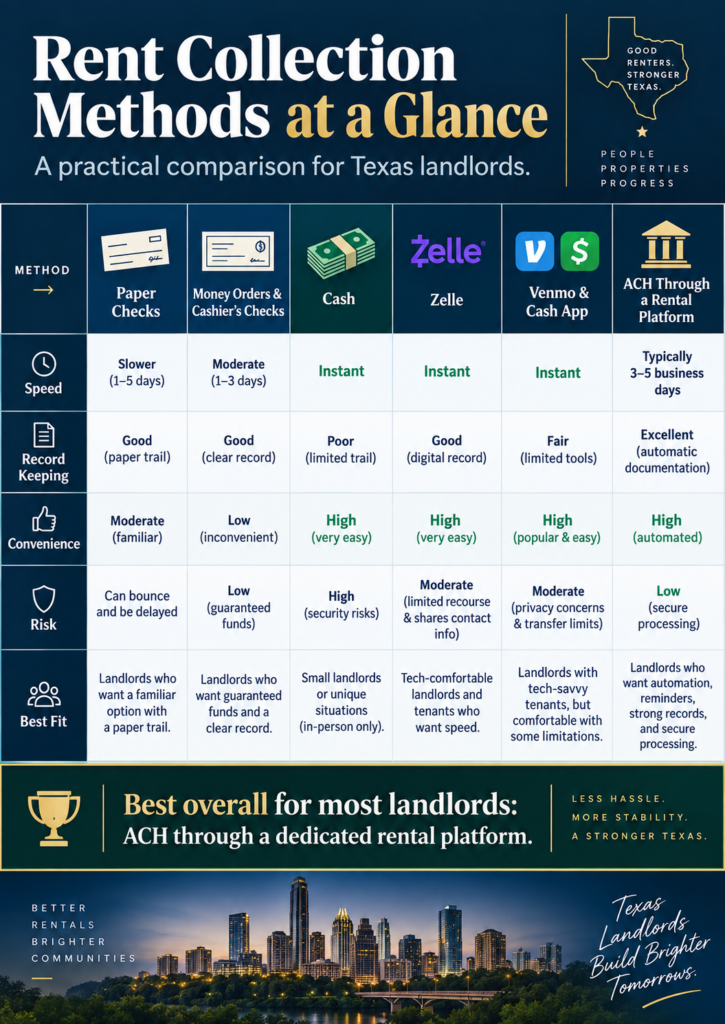
Collecting rent sounds simple enough. Your tenant owes you money on the first of the month, and you receive it. Done. But any landlord who has been in the game for more than a year knows that the “how” of rent collection matters just as much as the “when.” The method you choose affects your cash flow, your record-keeping, your legal standing, and frankly, your stress level. With so many options available today, from a paper check slid under your door to a fully automated ACH transfer, it pays to understand what you are working with before you commit to a system.

Here is a practical look at the most common rent collection methods, along with the honest pros and cons of each.

Paper Checks

The paper check is the old reliable of rent collection. It has been around forever, most tenants know how to write one, and it creates a paper trail that both parties can hold in their hands.

The pros are straightforward. Checks are universally understood, require no technology on either end, and provide a physical record of payment. For older tenants or those without smartphones, a check may genuinely be the most accessible option. There is also something psychologically deliberate about writing a check, it is a conscious act that some landlords feel reinforces the seriousness of the obligation.

The cons, however, are significant in today’s world. Checks can bounce, and by the time you find out, several days may have already passed. Depositing a check requires a trip to the bank or at minimum a mobile deposit, which adds a step to your process. Checks can also get lost in the mail, “accidentally” delayed, or conveniently forgotten. And if a tenant is paying late, you have to physically receive the check before you can even begin to document the late payment.

“I had a tenant for two years who paid by check every single month,” says Carol B., a landlord in the Fort Worth area. “She was never late, and it worked fine. But when I got a new tenant who kept ‘mailing’ the check three days after the due date, I realized pretty quickly that checks give tenants a lot of wiggle room. I switched to online payments after that.”

For landlords with long-term, highly reliable tenants, checks can work just fine. But as a default system for new tenants, they introduce unnecessary friction and ambiguity.

Money Orders and Cashier’s Checks

Money orders and cashier’s checks are essentially the guaranteed-funds version of a paper check. Because they are prepaid, they cannot bounce, which makes them a popular choice for landlords who have dealt with returned checks in the past.

The pros include that guaranteed-funds aspect, which eliminates the risk of a check bouncing and the associated bank fees. They also create a clear paper record, and many landlords who require cash-equivalent payments, particularly after a tenant has had a returned check, find money orders to be a reasonable middle ground.

The cons are mostly about inconvenience. The tenant has to physically go to a bank, post office, or grocery store to purchase one, which adds friction to the payment process. There is also a small fee on the tenant’s end, typically $1–$2 for a money order. From a landlord’s perspective, you still have to physically receive and deposit the payment, which means the same logistical limitations as a paper check apply.

Money orders work well as a fallback, particularly after a bounced check, but they are rarely the best primary system for ongoing rent collection.

Cash

Some landlords, particularly those managing informal arrangements or renting to tenants without bank accounts, accept cash. It is immediate, it is liquid, and there is no waiting for a transaction to clear.

The pros are limited but real. Cash is instant. There are no processing fees, no bank holds, and no technology required. For tenants who are unbanked, a population that exists in every Texas city, cash may be the only viable option.

The cons are substantial. Cash leaves no automatic paper trail unless you are diligent about issuing written receipts every single time. It creates a security concern, both for you and for your tenant who may be carrying a significant amount of money. It is also difficult to document for tax purposes and nearly impossible to dispute if a disagreement arises. Texas law does not require landlords to accept cash, and most experienced landlords strongly advise against it as a standard practice.

If you do accept cash under any circumstances, issue a dated, signed receipt every single time and keep a copy for your records. No exceptions.

A word from our sponsor: Landlords, want the benefits of professional property management without the uncertainty? Go4Rent’s property management services help handle the day-to-day while protecting your rental income. From tenant screening and leasing to ongoing management, Go4Rent makes owning rental property simpler, more predictable, and less stressful. Learn more at Go4Rent.

Zelle

Zelle has become one of the most popular peer-to-peer payment tools in the country, largely because it is built directly into the mobile banking apps of most major U.S. banks. Transfers are nearly instant, and there are no fees for either party.

The pros are hard to argue with. Zelle transfers typically arrive within minutes, which means you know immediately whether the payment has been made. There are no processing fees, the transaction history is documented within your bank app, and most tenants are already familiar with the platform. For landlords managing one or two properties, it is a genuinely convenient option.

The cons require careful consideration. Zelle is designed for payments between people who know and trust each other, and it offers virtually no buyer or seller protection. If a tenant sends money to the wrong account, or if a dispute arises over whether a payment was made, Zelle’s recourse options are extremely limited. There is also a practical issue: Zelle payments are tied to a phone number or email address, which means your personal contact information is shared with your tenant. Some landlords are comfortable with that; others are not.

“I used Zelle for about a year and it was great, until it wasn’t,” says Tony R., a landlord managing three rental homes in the Houston suburbs. “One tenant sent the payment to an old phone number I had, and it took weeks to sort out. Now I use a property management platform for rent collection. The peace of mind is worth the small fee.”

Zelle is a solid option for landlords with trusted, tech-savvy tenants, but it is worth understanding its limitations before making it your primary collection method.

Venmo and Cash App

Venmo and Cash App occupy a similar space to Zelle, peer-to-peer digital payments that are fast, familiar, and fee-light. Venmo in particular has a social feed component that, by default, makes transactions visible to others, which is a privacy concern worth noting for both landlords and tenants.

The pros mirror those of Zelle: speed, convenience, and widespread adoption among younger renters. Both platforms also allow you to request payments, which can serve as a gentle automated reminder.

The cons go beyond the privacy issue. Neither platform is designed for landlord-tenant transactions, and both have transfer limits that could be problematic for higher-rent properties. More importantly, neither offers the kind of documentation, late fee automation, or record-keeping integration that a dedicated rental platform provides. Using Venmo or Cash App for rent collection is workable, but it is a workaround rather than a solution.

ACH Transfers Through a Dedicated Rental Platform

Automated Clearing House (ACH) transfers are the backbone of most dedicated property management and rent collection platforms, think Apartments.com Rental Manager, TurboTenant, Avail, and Go4Rent, among others. With ACH, tenants link their bank account to the platform, and rent is transferred electronically on a scheduled basis.

The pros are considerable. ACH transfers are highly reliable, create automatic documentation of every payment, and can be set up for autopay so that rent arrives without either party having to take any action. Most platforms also allow landlords to automate late fee calculations, send payment reminders, and generate year-end financial reports, all of which are enormously helpful come tax season. Critically, your personal bank account information is never shared with the tenant, and their information is never shared with you. The platform acts as a secure intermediary.

The cons are mostly minor. ACH transfers are not instant, they typically take three to five business days to settle, though some platforms offer faster processing for a fee. There may also be a small processing fee charged to the tenant, typically in the range of $1–$2 per transaction, which some tenants push back on. And of course, the system requires that both you and your tenant are comfortable using an online platform.

For most Texas landlords managing one or more single-family homes, ACH through a dedicated platform represents the gold standard of rent collection. It combines the reliability of a guaranteed transfer with the documentation and automation that make your life significantly easier.

Choosing the Right Method for Your Situation

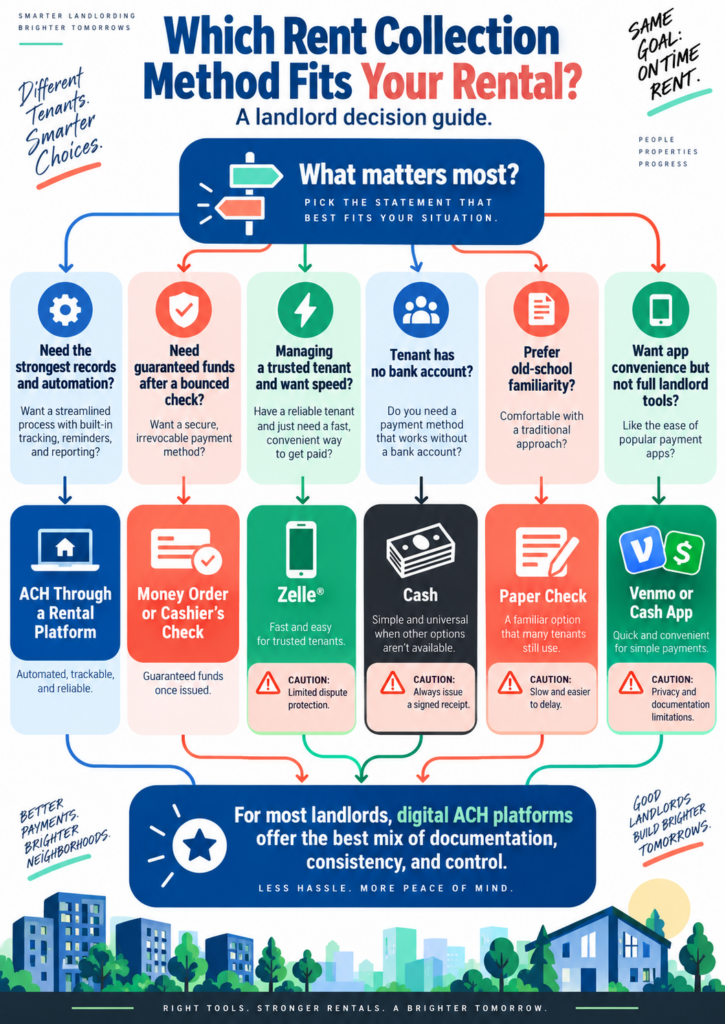
There is no single rent collection method that works perfectly for every landlord and every tenant. The right choice depends on your tenant’s preferences and technical comfort, the number of properties you manage, how hands-on you want to be, and how much documentation and automation you need.

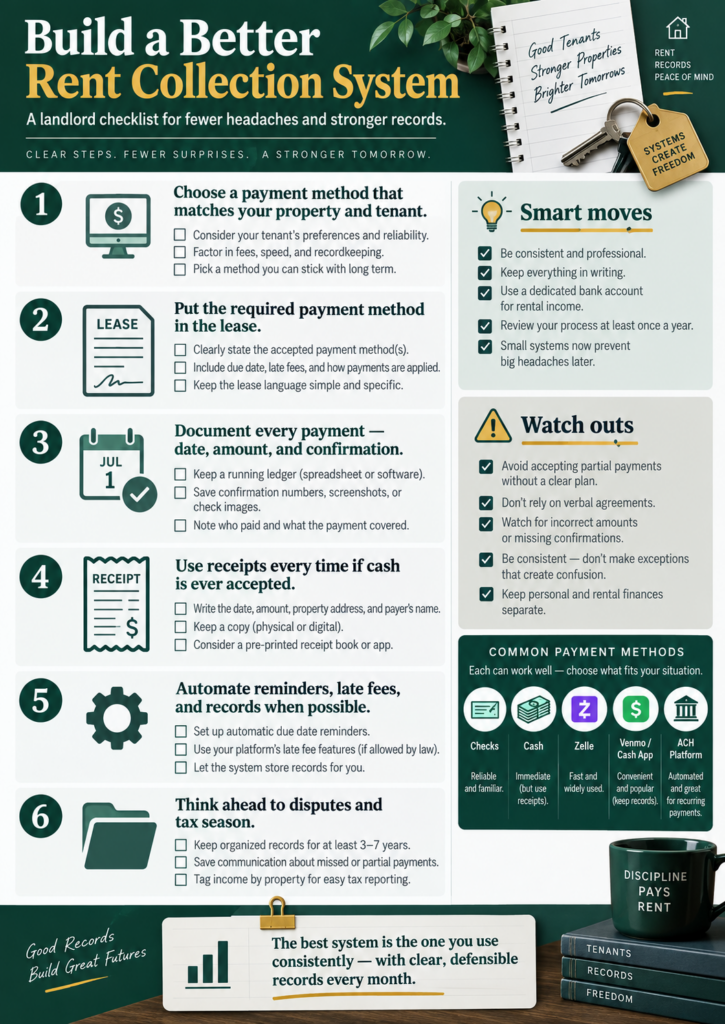
That said, a few principles hold true across the board. First, whatever method you choose, document every payment consistently, date, amount, and confirmation. Second, specify your required payment method in the lease agreement so there is no ambiguity later. Texas courts have generally upheld lease terms regarding payment methods, so putting it in writing protects you. Third, consider how your method of choice will hold up if a dispute ever arises. A Zelle transaction history or a platform-generated receipt will serve you far better in a dispute than a tenant’s word that they “dropped off a check.”

The broader trend among Texas landlords is clearly moving toward digital platforms with ACH capability. The combination of automation, documentation, and security is difficult to beat. Peer-to-peer tools like Zelle have their place, particularly for established landlord-tenant relationships, but they lack the infrastructure that makes rent collection truly effortless.

Ultimately, the best rent collection system is the one you will actually use consistently, and the one that gives you clear, defensible records every single month. In a state where the rental market moves as fast as Texas does, having that foundation in place is not optional. It is just good business.

From a New Orleans Condo to a Rental Industry Institution: The Story of Go4Rent

0

Some of the most enduring businesses start with a simple problem and a person stubborn enough to solve it differently than everyone else. Go4Rent is that kind of company. What began as one man’s attempt to rent out his own condo without paying a fortune to the local newspaper has grown into a trusted tenant screening, lease, and property management platform serving private landlords and real estate professionals. The story of how it got there is worth telling.

A Classified Ad That Became a Company

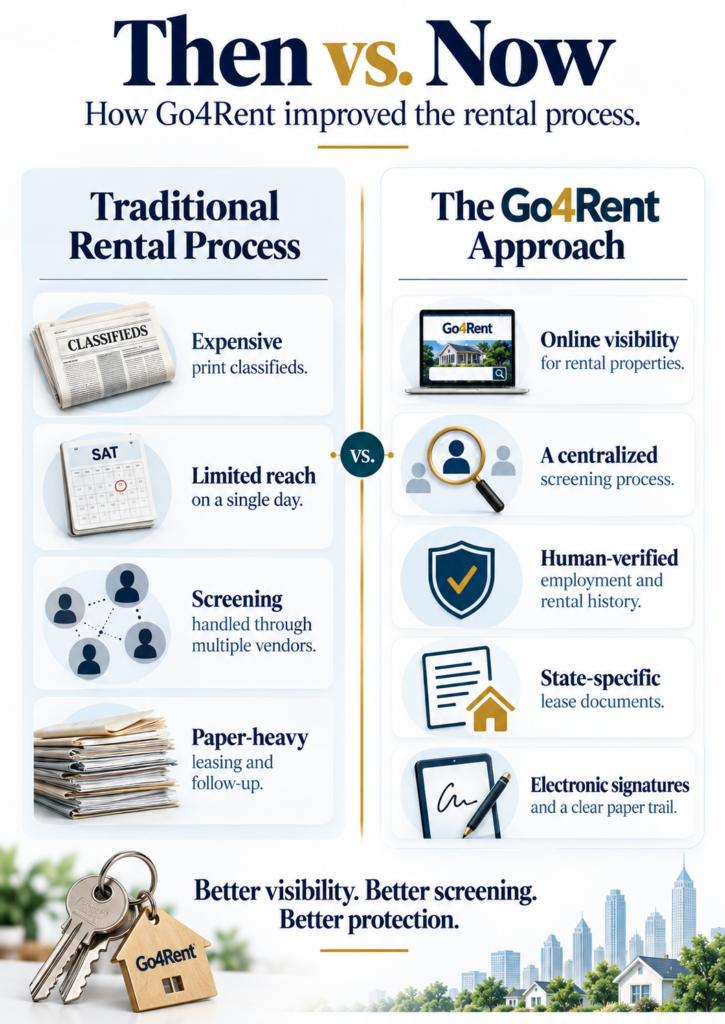
In the early 2000’s, Jonathan Coleman owned a condo in New Orleans and needed to find a tenant. Like most landlords at the time, he turned to the newspaper. What he found was that advertising in print was expensive, the ads were small, and the reach was limited to whoever happened to pick up that particular edition on that particular day. It struck him as an inefficient way to connect landlords with renters, especially as the internet was beginning to evolve.

Jonathan listed his condo on a website he built himself, and it worked. But he quickly realized that a rental website with a single listing was not much of a destination for prospective tenants. He needed more properties on the site to make it worth visiting, and he had a straightforward idea about where to find them.

Jonathan started calling the landlords he saw advertising in the newspaper directly. His pitch was simple: he could offer them more visibility online for less money than they were spending on a classified ad. The internet was still a novelty for many small landlords at the time, and the idea of reaching renters through a website rather than a print ad was not yet obvious to most people. But the economics were hard to argue with, and many of them said yes. The site grew, the listings multiplied, and Go4Rent began to take shape as a legitimate alternative to print advertising for rental properties in the New Orleans area.

The newspaper eventually noticed. When they figured out that Jonathan was using their classified section to recruit their own advertisers away from them, they stopped accepting his ads. It was a predictable response from an industry that was beginning to feel the pressure of the internet in every corner of its business. But by that point, it did not matter. Go4Rent had built enough of a user base and enough of a reputation that it no longer needed the newspaper to survive. The business had outgrown the very channel it had used to launch.

Katrina and a New Chapter

Hurricane Katrina changed everything for New Orleans in August 2005, and Jonathan was among the hundreds of thousands of people whose lives were upended by the storm. Like many who left Louisiana in the aftermath, he eventually settled in Texas, bringing with him both his professional ambitions and the business he had spent years building.

After relocating, Jonathan became a licensed real estate agent, and that transition opened his eyes to a gap in the market that he was uniquely positioned to fill. Realtors were regularly helping clients find rental properties, while private landlords were often handling the same process on their own. In both cases, screening was fragmented, inconsistent, and time-consuming. A realtor or landlord might use one service for a credit check, another for a background check, and then handle employment and rental history verification separately. The result was a process full of gaps, and those gaps were exactly where bad tenants slipped through.

Jonathan built a platform to close those gaps. Go4Rent evolved from a rental listing website into a comprehensive tenant screening and lease management service built around the needs of both private landlords and real estate professionals who wanted a reliable, efficient way to qualify applicants and protect rental properties. The company’s roots in the rental listing business gave it a perspective that purely technology-driven screening platforms lacked. Jonathan understood the landlord’s experience from the inside, and he also understood the demands placed on Realtors guiding clients through a rental transaction. He built Go4Rent to serve both.

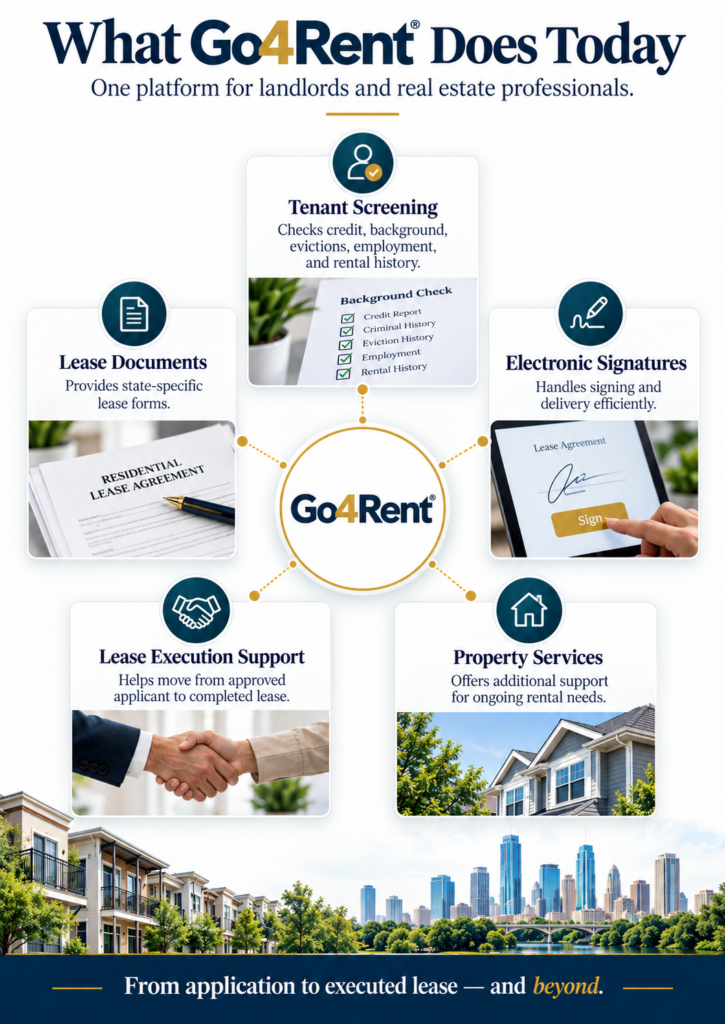
What Go4Rent Does Today

Go4Rent has grown considerably from its origins as a classified ad alternative, but the core philosophy has remained consistent: make the rental process more reliable, more transparent, and more protected for everyone involved. The company now offers a range of services that cover the full lifecycle of a residential tenancy, from the first application to the final lease renewal.

Tenant Screening

The foundation of Go4Rent’s service is its tenant screening process, and what sets it apart from the automated platforms that have become common in the industry is the human element built into every application. Go4Rent runs the standard automated checks, pulling credit reports, criminal background checks, and eviction history, but the process does not stop there.

Go4Rent’s processors manually verify employment and rental history by contacting employers and previous landlords directly, using independently sourced contact information rather than the phone numbers the applicant provides. This distinction matters more than most landlords realize. An applicant who has submitted a fraudulent pay stub or coached a friend to pose as a former employer is counting on the landlord to call the number they provided. Go4Rent’s processors find the number themselves, which is why they catch fraud that automated systems and less thorough screening services routinely miss.

The processors who handle these verifications are trained specifically in identifying fraudulent documents, fake identities, and suspicious social security numbers. They review enough applications to recognize the patterns that signal something is wrong, and they know when to dig deeper before clearing an applicant.

State-Specific Lease Documents

Go4Rent provides state-specific lease documents rather than relying on a one-size-fits-all generic template. The documents are selected for the property and jurisdiction involved and are updated to reflect applicable state requirements. For a private landlord managing a property directly, that means access to professional lease documentation without having to assemble an agreement from boilerplate language. For Realtors, it creates a more consistent process for helping landlord clients move from an approved application to a completed lease.

The platform handles electronic signatures and delivers fully executed copies to all parties, which means the entire lease execution process can be completed efficiently and with a clear paper trail.

The Elite Property Management Plan

For landlords who want the full protection of professional management combined with the income certainty that most management arrangements do not offer, Go4Rent’s Elite property management plan represents a significant step forward from what is typically available in the market.

Go4Rent manages the property and guarantees rent payment for all twelve months of the lease term. That guarantee is not conditional on tenant performance. If a tenant stops paying, breaks the lease, or is evicted, Go4Rent covers the lost rent and re-leases the home. The landlord’s income stream is protected from the first month of the lease to the last, regardless of what happens in between.

For a private landlord, this kind of arrangement changes the risk calculation entirely. The fear of a bad tenant, a broken lease, or months of vacancy while the property is re-marketed is one of the most common reasons owners hesitate to invest in additional rental properties. The Elite plan removes much of that uncertainty from the equation. Realtors can also introduce the program to landlord clients who want professional management and more predictable rental income after the lease is signed.

Investing in Go4Rent’s Next Chapter

Go4Rent is also preparing for the company’s next stage of growth through an investment fund created to support future plans and expansion. According to the company, several related funds have already completed the SEC filing process, and private placement memorandums are available upon request for qualified prospective investors.

The investment initiative is intended to give Go4Rent the resources to continue building its technology, expand its services, and bring the company’s tenant screening, state-specific lease documentation, and Elite property management model to more private landlords and real estate professionals. It is a natural extension of the same long-term approach that has guided the business since its earliest days in New Orleans.

“We have always grown by listening to what landlords and real estate professionals need and then building a better way to serve them,” Jonathan said. “This investment fund is about preparing Go4Rent for the opportunities ahead while staying true to the trust and personal service that built the company.”

Why Go4Rent Matters for Private Landlords and Realtors

Rental markets have grown and changed substantially over the past two decades. That growth has brought opportunity for private landlords and the Realtors who serve them, but it has also brought increased competition for quality tenants and greater exposure to fraud and misrepresentation. Rental application fraud has become more sophisticated, and the owners most vulnerable to it are often private landlords managing one or a handful of properties without the institutional resources that large apartment communities take for granted.

Go4Rent was built for exactly this environment. Its roots in the real estate industry, combined with its emphasis on human verification rather than purely automated screening, make it particularly well suited to privately owned rental homes, where the stakes per property are high and the consequences of a bad placement are significant. A private landlord who places the wrong tenant does not have dozens or hundreds of other units absorbing the financial impact while the problem is resolved. The cost of a bad tenancy lands entirely on one property and one owner.

For real estate professionals, Go4Rent functions as a one-stop platform that handles the screening and lease execution side of a rental transaction efficiently and reliably. Rather than managing multiple vendors or piecing together a screening process from different services, a Realtor working with Go4Rent can move from application to executed lease with a single platform and a team of experienced processors. It gives agents a dependable process to offer landlord clients without requiring the agent to become the screening department.

For private landlords managing their own properties, Go4Rent offers access to thorough screening and state-specific documentation without requiring them to hand over day-to-day control of their investment. For those who want full management, the Elite plan offers professional oversight and a guaranteed income stream for the full lease term. Realtors benefit from having both options available, whether a client wants help only with screening and lease execution or prefers to place the property into full-service management.

From a Classified Ad to a Platform Built on Trust

Jonathan started Go4Rent because he thought there was a better way to connect landlords and tenants than a small-print newspaper ad. What he built, over the course of more than two decades and through a hurricane that reshaped his life and his business, is a company that has made the rental process more reliable and more protected for private landlords and the real estate professionals who serve them.

The classified ad is long gone. The company it inspired is still here, still growing, and still solving the same fundamental problem it started with: helping landlords find the right tenant and protecting them when things do not go according to plan.

This article is intended for informational purposes. Landlords and real estate professionals are encouraged to contact Go4Rent directly for current service details and pricing.