This Content Is Only For Subscribers
Little Elm has changed dramatically over the past two decades. What was once a relatively small lakefront community has become one of the larger fast-growing suburbs on the northern side of the Dallas-Fort Worth metroplex, while still keeping Lewisville Lake at the center of its identity.
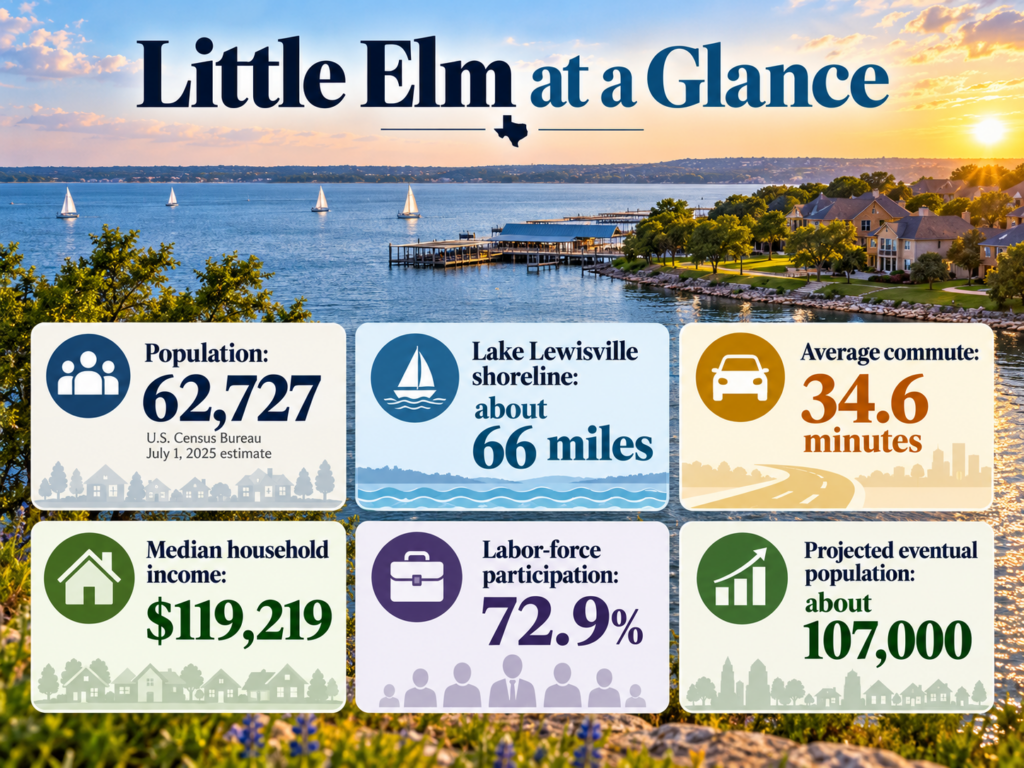
The growth numbers tell the story. Little Elm had 46,453 residents in the 2020 Census. The U.S. Census Bureau estimated 62,727 residents as of July 1, 2025, a 36.2% increase from the 2020 estimates base in only five years. The Little Elm Economic Development Corporation put the town’s population slightly higher at 63,485 in October 2025and projects an eventual buildout population of approximately 107,000.
That growth has changed Little Elm from a quiet community where many residents looked elsewhere for shopping, dining and employment into a much more complete suburb. Even so, the lake remains what separates Little Elm from many of its North Texas neighbors. The town has approximately 66 miles of shoreline along Lewisville Lake, and recreation, development and community events continue to revolve around the water.

Jobs in Little Elm
Little Elm is still closely connected to the larger North Texas employment market. The average commute for workers was 34.6 minutes in the Census Bureau’s 2020-2024 data, reflecting the number of residents who travel to surrounding employment centers such as Frisco, Plano, Denton and other parts of the DFW area.
At the same time, Little Elm’s own employment base has continued to develop. The Little Elm Economic Development Corporation currently identifies Little Elm ISD, the Town of Little Elm, Retractable Technologies, Lowe’s, Kroger and Holt CAT among the community’s major employers. The town’s labor-force participation rate was 72.9% for residents age 16 and older in the latest Census data.
Household income has climbed with the town’s growth. The Census Bureau reports a median household income of $119,219, based on 2020-2024 data. Little Elm EDC’s own demographic profile places median household income even higher, at $126,004.
Commercial development is also becoming a larger part of the picture. The US 380 corridor saw a major expansion in 2026, led by the Target-anchored Bates Towne Crossing development in the broader Little Elm area. Additional restaurants, retailers, banks and service businesses have been announced or developed around the project, giving residents more options closer to home than Little Elm offered just a few years ago.
Education in Little Elm
Public education in Little Elm is a little more complicated than the town name might suggest because addresses within the community can fall into Little Elm ISD, Frisco ISD or Denton ISD depending on location. The Economic Development Corporation identifies all three districts as serving portions of Little Elm.
Little Elm ISD remains the district most closely associated with the community. It finished the 2025-26 school year with 7,572 students and projected enrollment of approximately 7,456 for 2026-27. The district serves not only Little Elm but also portions of Frisco, Hackberry, Lakewood Village, Oak Point and The Colony.
The district has expanded along with the area. Its current campuses include seven elementary schools, two middle schools, Little Elm High School and the Zellars Early Childhood Learning Center. Little Elm ISD is also a NISE STEM Certified District and has received recent recognition for its career and technical education, visual arts and music programs.
For 2026, Little Elm ISD reported an overall state accountability score of 78, while Little Elm High School earned an 84, or B rating, from the Texas Education Agency.
Higher education is also readily accessible. The University of North Texas in nearby Denton enrolled 42,016 students in fall 2026, while UNT’s growing Frisco presence enrolled another 3,377 students. The broader North Texas area gives Little Elm residents access to a large network of public and private colleges without requiring a move to another region.
Quality of Life in Little Elm
It is difficult to talk about quality of life in Little Elm without starting with the lake.
Lewisville Lake shapes the town physically as well as culturally. Little Elm’s 66 miles of shoreline provide residents with access to swimming, boating, fishing, kayaking, paddleboarding, trails and lakefront parks. Little Elm Beach remains one of the community’s signature attractions and is promoted by the town as the largest beach in North Texas. It includes a large swimming area, sand volleyball and access to nearby water-sport rentals.
Little Elm’s park system offers more than the beach. McCord Park is a 38-acre wooded park with more than a mile of hike-and-bike trail, an 18-hole disc golf course, fishing pond, splash pad, dog park, playgrounds and pedestrian bridges. Cottonwood Park offers lake views, walking trails, shoreline fishing and access to Cottonwood Creek Marina. Little Elm Park adds athletic facilities, hiking and biking trails, picnic areas, beach access and a boat ramp.
The town’s quality of life has also received national attention. In May 2026, the Town of Little Elm reported that U.S. News & World Report ranked Little Elm No. 100 nationally in its 2026-27 Best Places to Live rankings and No. 30 among Texas communities included in the study.
One tradeoff is transportation. Little Elm remains heavily automobile-oriented. Walk Score currently gives the city an average Walk Score of 24, placing it in the “car-dependent” category, and describes bicycle infrastructure as limited. Individual areas can be more walkable, particularly around concentrated commercial development, but most residents should expect a car to remain part of everyday life.
Shopping, Dining and Entertainment in Little Elm
Little Elm’s entertainment identity has become increasingly centered around The Lakefront at Little Elm, the town’s lakefront dining, recreation and event district.
The district brings together Little Elm Beach, The Cove, The Rec, Cottonwood Creek Marina, water sports, restaurants, trails and The Lawn, a public gathering space that hosts concerts, markets, movies and special events. Annual events and seasonal programming have helped turn the area into more than a summertime destination.
One of its biggest attractions is The Cove at The Lakefront, a 42,000-square-foot indoor water park. It operates year-round and includes water slides, a lazy river, interactive play areas, pools and a FlowRider double surf machine.
Another familiar name has returned in a new form. Tinman Social reopened in 2026 under new management after a significant redesign. The current venue combines two restaurants with entertainment that includes bowling, karaoke, billiards, golf simulators, arcade games and other activities.
Dining choices in the Lakefront District now include a mix of restaurants, casual food stops and bars, while development along US 380 is adding another concentration of retail and restaurants. The days when Little Elm residents had to leave town for nearly every major shopping trip are fading, although nearby Frisco and other surrounding communities still greatly expand the range of shopping and dining available within a short drive.
Cost of Living in Little Elm
Little Elm is no longer the inexpensive lakeside suburb it once was.
The U.S. Census Bureau reports a median gross rent of $1,953 per month for 2020-2024 and a median value of $420,700 for owner-occupied homes. Approximately 70.1% of occupied housing units were owner occupied during that period. Those figures should not be confused with the asking rent or sales price of a particular property in 2026, but they provide a useful picture of how much the market has changed.
The higher housing costs are accompanied by relatively high household incomes. With median household income at $119,219 in the Census data, Little Elm has a considerably different economic profile today than it did during the early stages of its population boom.
PayScale’s current cost-of-living estimate puts Little Elm at approximately 8% above the national average, with housing about 6% above the national average and utilities about 13% higher. That is lower than the 14% figure cited in older versions of this article, although cost-of-living indexes vary depending on methodology.
Rapid growth also means infrastructure costs continue to change. The Town has scheduled increases in water rates, including a residential minimum water charge of $31.30 beginning October 1, 2026, before sewer, refuse and other applicable charges are added.
Other Notable Facts About Little Elm
- Little Elm is one of Denton County’s older communities. The town’s historical materials trace settlement to 1844, when C.C. “Kit” King established a community along Little Elm Creek.
- Little Elm officially incorporated in 1966, which means the town celebrated its 60th anniversary in 2026. The original incorporation vote passed by only 37 votes to 34.
- The community had only 363 residents in the 1970 Census. By the Census Bureau’s July 2025 estimate, the population had reached 62,727, illustrating just how dramatically Little Elm has changed over the past half-century.
- Little Elm’s approximately 66 miles of Lewisville Lake shoreline remain central to its branding as the “Town with a Lake Attitude.”
- Little Elm hosted the inaugural IRONMAN 70.3 Dallas-Little Elm in March 2026, bringing another major sporting event to the community’s lakefront.
The town’s official website is LittleElm.gov.